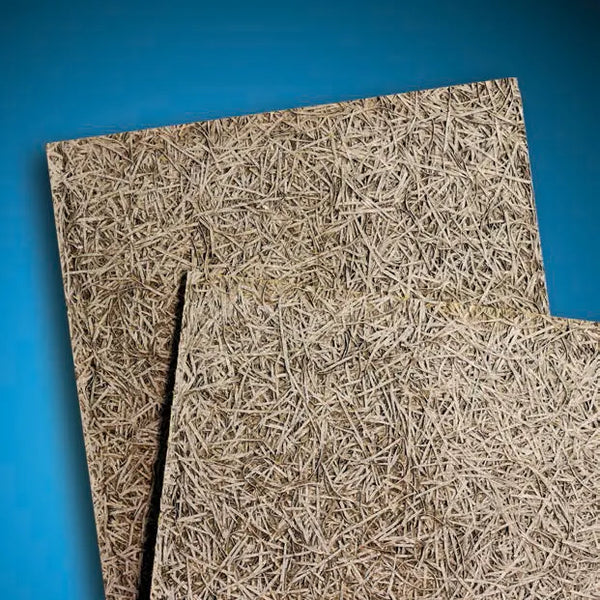
What is wood wool board?
Wood wool board is made from long, thin strands of wood, usually spruce, which are mineralised and then bonded with a mineral binder, usually cement, into a rigid panel. Mineralising the wood protects it from rot, insects and fungus, and greatly improves its fire resistance. Boards are made to EN 13168, and have been in use for many decades.
The open, fibrous surface is what makes it useful. It gives plaster and render something to grip, much as timber laths did in older buildings.
We supply two wood wool boards: Savolit Plus and Fibrolith. Where this article gives specific figures, they are for Savolit Plus; check the Fibrolith data sheet for its values.
Why use it instead of plasterboard?
Gypsum plasterboard is designed for gypsum skim. It is not a good base for lime plaster, and once painted it does little to manage moisture in the wall. Wood wool board differs in several ways:
-
Lime compatible. The fibrous face gives lime a mechanical key, so a lime finish bonds well.
-
Vapour open. With a vapour diffusion resistance factor of μ 5, moisture vapour can pass through the lining.
-
Humidity buffering. The board absorbs and releases 2–3.5 litres of moisture per m², evening out peaks from cooking, bathing and drying clothes.
-
Thermal mass. Its density adds heat storage to lightweight timber walls, helping keep rooms cooler in summer.
-
Robust. It is unaffected by moisture and frost, and is classed Euroclass B-s1, d0 for reaction to fire.
Where it is used
-
Internal lining of timber frame walls
-
Lining stud walls built for internal wall insulation on solid masonry
-
Ceilings and internal partitions
-
Render carrier on the outside of timber frame walls
In Bio Space's stud wall IWI and timber frame build-ups, wood wool board is the internal lining, fixed over the service void and finished in lime.
Boards are fixed in a broken bond (staggered joints) to studs, battens or the frame, using screws with large washers that spread the load over the board face. Screw length and support centres depend on board thickness. The figures below are for Savolit Plus; for Fibrolith, follow its installation guide:
|
Board |
Screw (min. length × Ø) |
Support centres |
Min. screws per m² |
|---|---|---|---|
|
15mm |
45 × 4.8mm |
400 or 600mm |
See installation guide |
|
25mm |
50 × 4.8mm |
400 or 600mm |
15 |
Support centres usually follow the stud or batten spacing, typically 400mm or 600mm. Check the manufacturer's installation guide for the maximum span of each board.
If every board edge is bonded with a bead of adhesive, board ends no longer need to land on a support, and 25mm board can span up to 666mm.

A typical internal lime finish is:
-
Lime base coat, 3mm
-
Glass fibre mesh, bedded into the wet base coat
-
Second lime base coat, 3mm, once the first has hardened
-
Lime finish coat, 2mm in two passes
The mesh spreads stresses across the board joints and is what stops them showing through as cracks.
Choosing a thickness
We supply wood wool board in two thicknesses:
-
15mm is for internal walls. It is the lighter lining board for timber frame and stud walls, finished in lime plaster. Its fixing pattern is given in the manufacturer's installation guide, available under Downloads on the product page.
-
25mm is for external walls and ceilings. It is stiffer, so it is used as a render carrier on timber frame and for ceilings.